
May 5, 2026
Rethinking Active Surveillance: First Validated Urine Test for Prostate Cancer Monitoring

Active surveillance is widely used to manage men with low-risk prostate cancer, helping avoid unnecessary treatment while monitoring for signs of disease progression. However, current monitoring approaches still rely heavily on repeat biopsies and imaging—tools that can be invasive, costly, and difficult for patients to maintain over time.
This creates a persistent clinical challenge: How do clinicians confidently identify the patients who need biopsy while sparing those who do not?
A recently published study in The Journal of Urology highlights a promising new direction.
In a multisite validation study, investigators evaluated MyProstateScore 2.0 – Active Surveillance (MPS2-AS), a non-invasive urine test developed by Lynx Dx to help guide biopsy decisions in men already diagnosed with low-grade prostate cancer.
By providing personalized risk estimates for disease upgrading, the test is designed to support more informed and individualized surveillance decisions.
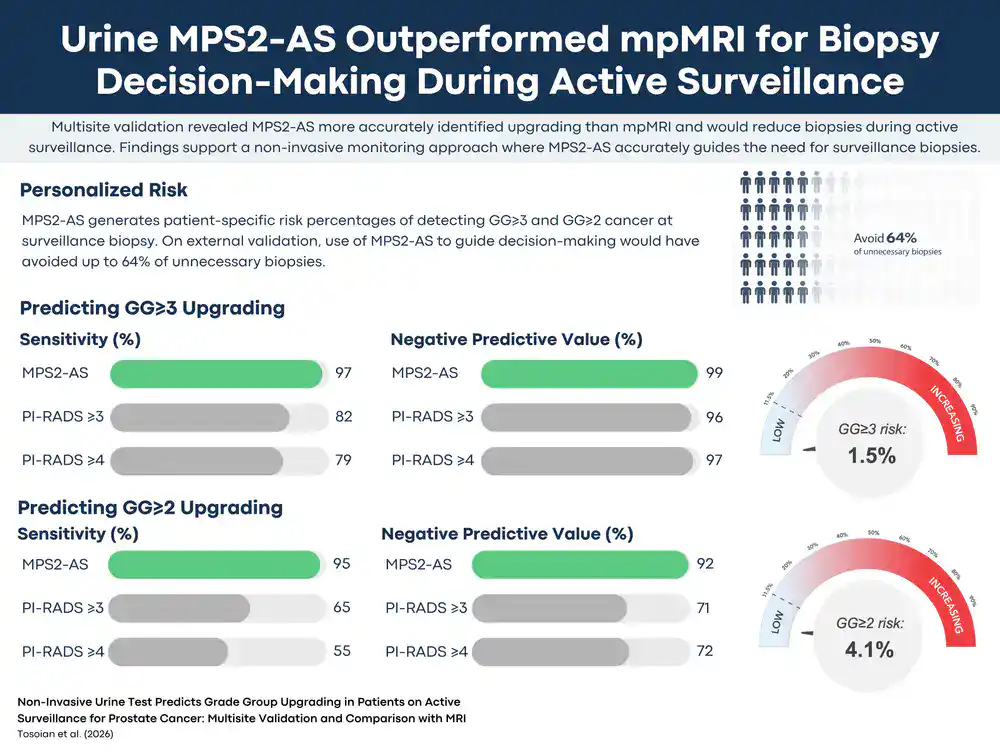
The researchers found the test outperformed multiparametric MRI (mpMRI), supporting the increasingly important role of molecular diagnostics in improving risk stratification and enabling more informed clinical decision-making during active surveillance.
Key findings from the paper include:
- 97% sensitivity for detecting Grade Group ≥3 upgrading (99% negative predictive value)
- 95% sensitivity for detecting Grade Group ≥2 upgrading (92% negative predictive value)
- Up to 64% of unnecessary biopsies could have been avoided
- MPS2-AS outperformed mpMRI for detecting upgrading
MPS2-AS is the first urine-based biomarker test validated to predict risk of progression in men on active surveillance. It is being developed to support a convenient, non-invasive collection process that can be performed at home or in office, without the need for DRE or temperature-controlled shipping.
These findings represent an important step toward a more precise, non-invasive, biomarker-driven approach to active surveillance.
Paper Cited: “Non Invasive Urine Test Predicts Grade Group Upgrading in Patients on Active Surveillance for Prostate Cancer: Multisite Validation and Comparison with MRI,” Journal of Urology. DOI 10.1097/JU.0000000000005095